
Jump to:
You might be wondering how Christmas is celebrated in Japan, especially since Christianity is not the country's dominant religion.
Is Christmas a public holiday? Do Japanese people go to church, exchange gifts, or enjoy a special Christmas dinner? And what do they actually eat instead of the traditional turkey?
From KFC and strawberry shortcake to romantic Christmas Eve dates and festive illuminations, let's explore how Japan celebrates this surprisingly unique holiday.
Brief History of Christmas in Japan
Once upon a time, Christianity was banned in Japan. And no, the Grinch had nothing to do with it!
Japanese Christians were among those who fought on the side of Toyotomi Hideyori during the Siege of Osaka (1614–15), one of the final major conflicts of Japan's civil war era. Around this time, the Tokugawa government intensified its crackdown on Christianity, issuing a nationwide ban in 1614.
As the Tokugawa Shogunate tightened its grip on Japan, foreign missionaries were expelled, churches were destroyed, and Christians faced severe persecution. Many Japanese Christians were forced to abandon their faith publicly or practice it in secret.
Then came the Meiji Restoration. In 1873, the ban on Christianity was lifted, and Christmas gradually returned to public life. This time, its appeal extended beyond religion. Western customs and fashions were gaining popularity, and Tokyo's fashionable Ginza district became an important center for introducing Christmas traditions. By 1875, Japanese-organized Christmas celebrations were taking place, and early Japanese depictions of Santa Claus were appearing. In 1910, confectioner Fujiya began selling Christmas cakes in Yokohama.
Do People Really Celebrate Christmas in Japan?
Yes! People in Japan really do celebrate Christmas, but there's one important difference: December 25 is not a public holiday in Japan.
Unlike countries where Christmas is a major religious and family holiday, Japan treats it more as a festive seasonal occasion. Most people go about their usual work and school routines, while enjoying Christmas lights, special meals, shopping, and seasonal celebrations.
Kids love Christmas in Japan though because public schools start their winter vacation around the 25th or 26th of December, a few days before the national New Year vacation begins on December 29th (which is not an official holiday).
Incidentally, the Taisho emperor died on December 25th, 1926, so December 25th was a public holiday from 1927 to 1947. Also, the previous Heisei emperor celebrated his birth as a national holiday on December 23rd, but that holiday ended in 2019 at the start of the Reiwa Era, leaving December a month with no official national holidays!
How is Christmas ‘Celebrated’ in Japan?
It should be noted that people in Japan generally attach no or very little religious sentiment to Christmas. From personal inquiry and curiosity over the years, a lot of people express uncertainty whether it celebrates the birth or death of Jesus Christ.
The answer, anyway, is 50/50, but this is what you can expect if you’re in Japan for the festive season:
Kentucky Fried Chicken: A Japanese Christmas Dinner

KFC arrived in Japan in 1970. Four years later, it launched a national campaign under the slogan “Kurisumasu ni wa Kentakkii,” or “Kentucky for Christmas.” The promotion was a bucket of fried chicken paired with a bottle of wine. It was pitched at adults hosting Christmas parties rather than the family treat that it now is.
The KFC tradition has nothing to do with confusing Santa with Colonel Sanders as his doppelgänger. Some stories relate its origins to a salesperson noting that foreigners (mostly Americans) had no decent option for a turkey. Other versions give credit to a store manager. Regardless, the concept was a hit, and, with Japan having no other Christmas meal of its own, it has now entered its 53rd year.
If anything, KFC is a great way to start kids off on their summer vacation, and housewives can take a day off from cooking! In 2019, KFC pulled $62.5 million over the 3-day Christmas sales period. That was roughly one third of KFC Japan's entire annual revenue, which is more than enough reason to keep on celebrating!
Christmas Cake: What it Means in Japan

Japan’s Christmas cake began in Yokohama. In 1910, Fujii Rinemon opened the confectioner Fujiya in Motomachi, next to the districts where foreign residents lived and worked. That December, he sold his first Christmas cake. It was a European-style fruitcake with a sugar glaze, and looked nothing like the cake Japanese eat today.
The modern version arrived in 1922. Fujii had studied confectionery in the United States, where he had tried strawberry shortcake. He replaced its biscuit base with soft sponge and topped it with whipped cream and strawberries. Unlike traditional fruitcake, it captures the red and white theme of Christmas.
Many families still pick one up on December 24. German stollen, first sold in Japan by a Fukuoka confectioner in 1969, has also been a pre-Christams favourite since early 2010.
Christmas Eve: The Highest Value Couple’s Day in Japan

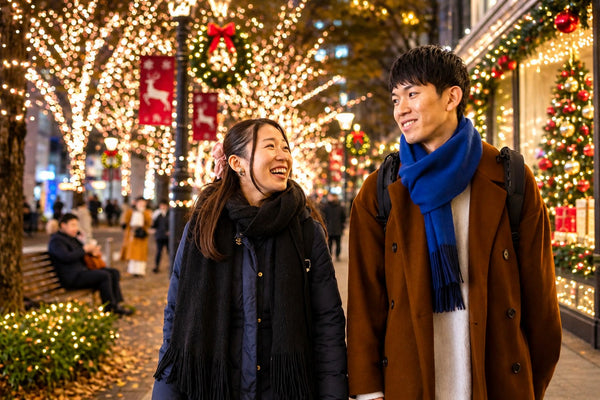
Christmas Eve in Japan can read like an episode of “Date Night”. Couples love to book especially French or Italian restaurants weeks ahead, then walk through the winter illuminations afterward to heighten the intensity of their romance.
This trend seems to have started towards the mid 1980s and was picked up on and popularized by TV dramas. Tatsuro Yamashita’s 1983 hit song ‘Christmas Eve’ and Yumi Matsutoya’s 1980 ‘Koibito wa Santa Claus’ (My Lover is Santa) date from this era and still play every December. ‘Christmas Eve’ holds a Guinness World Record for charting on Oricon for 30 consecutive years.
The pervasiveness of ‘Christmas couples’ led to the coining of the word ‘kuribotchi’. It joins ‘kuri-sumasu’ (Christmas) with ‘hitori-botchi’ meaning ‘along or single’. The term surrfaced online in the early 2010s as a type of self-mockery. The tone has since softened with societal norms resigned to the rise of single lifestyles and businesses cashing in on the fad of one-person Christmas cakes.
German Style Christmas Markets: Why Not?
 German-style Christmas markets are a more recent thing. The most famous market was first held in Sapporo in 2002 to mark 30 years of sister-city ties with Munich. The two cities had paired in 1972 when Munich hosted the Summer Olympics and Sapporo the Winter Games.
For about a month, wooden stalls in Odori Park sell ornaments, German sausages, pretzels and hot spiced wine. The market sits inside the Sapporo White Illumination, which has lit the park every winter since 1981. Sapporo has also adopted Munich’s practice of reusable dishware at its stalls.
Other cities soon followed with the Tokyo Christmas Market modelled on Dresden’s traditional market. Yokohama holds its market at the Red Brick Warehouse on the harbour, a building that carries some German architectural influence.
Christmas Decorations or Seasonal Illuminations?

Christmas decorations first appeared in Ginza shop windows of Meidi-ya, an import grocer after moving its store from Yokohama to Ginza in 1900. Its founder, Isono Hakaru, had studied in England and wanted to recreate the experience. Other Ginza stores followed with customers being wealthy Tokyoites curious about Western goods.
Although winter illuminations grew from these beginnings, few illuminations are specifically about Christmas. The Kobe Luminarie began in 1995 to commemorate the Great Hanshin-Awaji Earthquake, with designs by Italian artists. The Ashikaga Flower Park in Tochigi uses millions of LEDs to recreate its wisteria in winter.
In Tokyo, Roppongi Hills lights up Keyakizaka avenue with about 800,000 white and blue LEDs until Christmas Day. Then the season ends abruptly and kadomatsu and shimekazari go up for the more important holiday of Japanese New Year.
Gifts on Christmas Eve: Am I Getting Anything?

Everyone knows that Santa brings gifts, and in 1900, author Shindo Nobuyoshi published the first Japanese Chritsmas story book called “Santa Kuro”.
It’s set around a Christian family in Nagano who rescue a farmer in the snow. The family falls on hard times, but the following year on Christmas Eve, the man they rescued returns with three large bags of gifts and two bales of rice, carried by 45 buff young men instead of reindeer. He left a note signed “三太九郎” or Santa Kuro which reads as a phonetic rendering of ‘Santa Klaus’.
Christmas as a day for children started to gain traction, however, around 1906. Today, Christmas gifts still go mainly to children. Toymaker Bandai has surveyed parents every year since 1995. In 2025, the average budget for a child’s present was ¥8,378 (tax included).
The most common place for a Christmas gift is by the child’s pillow when they’ve ‘fallen asleep’ (32.3%). Nicely wrapped gifts under a tree come in at 20.8%.
Colleagues and extended family rarely swap or give gifts on Christmas. Those relationships are honored through oseibo, or year-end gifts sent in December.
How do Japanese Christians Celebrate Christmas?
Sometimes it does feel odd to have all the Christmas trappings in a country that often sees itself as ‘having no religion’, no underlying Christian values, and a Christian population of only slightly more than 1%.
So where does that leave Japanese Christians who rightfully should not be overlooked on Christmas Day!
For Japan’s Christians, Christmas is still a religious celebration. Because December 25 is a working day for most people, churches around the country are packed on Christmas Eve, and non-Christian family members often come along with relatives who are believers.
Christmas Eve mass has also become a stop on many couples’ date nights. A Polish missionary in Aichi Prefecture once reported that about 90 percent of the people at his midnight mass were non-Christians.
Getting the Most out of Christmas in Japan

Generally, people don't go to church since only 1% to 1.5% of Japanese are Christian. Japanese Christians, however, usually attend Christmas Eve mass. In recent years, Christmas Eve mass has become popular with non-Christians, especially young dating couples.
For those from traditional Christian communities, Christmas in Japan can be a lonely affair especially if there is no family or you’ve retired from the dating scene. However, if you live in a major center, there are various locations to attend Christmas mass or a Christmas Eve service.
In Tokyo, popular venues include the Sekiguchi and St. Ignatius Catholic churches, the Franciscan Chapel Center and the Tokyo Union Church. Nagoya Cathedral or Nagoya Union Church are popular as is the Osaka-Takamatsu Cathedral or Osaka International Church. The oldest Christian site in Japan is the Oura Cathedral in Nagasaki.
Celebrate the Holidays with Japanese Gifts
Although Christmas Day is not a public holiday or primarily a religious celebration in Japan, people enjoy festive illuminations, romantic Christmas Eve dates, KFC dinners, strawberry shortcake, and gift-giving.
If you're looking to bring a little Japanese holiday spirit to your celebrations, explore our Japanese holiday gift guide and ready-to-give Japanese holiday gift baskets. Shopping on a budget? Check out our gift guide with gifts under $50 for everyone on your list for more affordable inspiration
If you're interested in learning about Japanese New Year and Oshogatsu, read our guide to discover how Japan welcomes the New Year through its traditions, foods, and celebrations.


0 評論