
Jump to:
Maneki Neko is Japan’s lucky cat (not to be confused with Hello Kitty!). You tend to see them near the registry in shops, and maneki-nekos are quite popular in other Asian countries too.
Walk into any souvenir shop and you may come across one or more pulling on your strings with a cute, raised paw saying, “Come on over here!”
You may notice too that some have a right paw raised and others a left. So what does this mean, and how can you choose the right one for yourself or as a gift?
The right paw raised is basically for attracting personal abundance, good fortune or opportunity. The left pawed cat is displayed mostly in businesses to attract customers (like you).
Things such as the height of the paw matter too. Below the ear is kind of modest, or attracting good things everyday. Raised above the ear and head often signifies bigger dreams like your future car or house.
If you need to know more, this guide will navigate you through the ever-expanding world of maneki-neko, keeping it simple, practical and to the point.
A Brief History and Some Maneki-Neko Stories

According to Asahi Shimbun, back in the 1630s, a feudal lord named Ii Naotaka was heading home from a falconry outing when he noticed a cat sitting at the gate of Gotoku-ji Temple, raising its paw as if it were saying, “Psst, over here…”
He wandered in and began talking with the temple master. Not long after, the skies opened up and the rain poured down. The feudal lord took the cat’s gesture as a sign of good fortune and became a benefactor of the temple. After the cat passed away, the monks honored it with a stone statue.
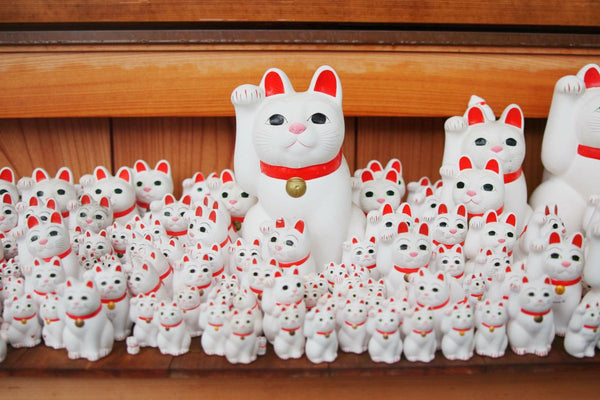
To this day, Gotoku-ji Temple in Tokyo is known for its simple white maneki-neko with red collars. According to the temple, its maneki-neko holds no coin because its purpose is to bring opportunities and connections that you must act on yourself. The temple also teaches that when you live with gratitude, luck and happiness can come naturally. A Gotoku-ji maneki-neko makes a meaningful souvenir from Japan, with a story and tradition you won’t find in a typical souvenir or gift shop.
Asahi Shimbun also introduces another well-known maneki-neko story from the late Edo period, about a poor, elderly woman who dreamed of a cat she had recently lost. She took the dream as a sign and began making clay cat figures to sell around Asakusa.
The legend says she made them in the Imado pottery style, and the figures became popular with local customers. Some early examples featured a seal with the Japanese character associated with completion or profit, surrounded by a circle. The cats were typically white with black markings and had one paw raised in the familiar beckoning gesture.
In 1852, these early Imado-style cats were documented in written records and depicted in ukiyo-e prints and paintings from the period. They are considered among the earliest documented examples of the maneki-neko tradition.
Types of Maneki Neko

Most types of maneki-neko fall into a few basic categories, specifically historic or modern representations, materials, and place of origin.
The traditional style traces back to Edo-period Japan and is a simple, plain white cat with one paw raised; no coin and no bright colors. The best place to get these is still Gotoku-ji Temple.
The most recognizable design is the one with big round eyes and a short, rounded body kind of like a British Shorthair cat. These started in the early 1950s from Tokoname, a pottery town just south of Nagaoya.

Seto, also in Aichi Prefecture, was the first location to mass produce ceramic maneki-nekos. Their style tends to be more slender, graceful with more street cat cred. Seto also houses the Maneki-Neko Museum and you can hand paint your own designs onto various cat-inspired ceramics.
Other makers like Shigaragi are famous for their rustic designs and Kutani ware from Ishikawa are extremely ornate and delicately painted.
Wooden versions are carved by hand rather than molded. Newer styles include metal, cheap plastic or resin for everyday shops, and battery or solar-powered cats with a moving arm, a design mostly linked to Chinese-made cats.
Regardless of the type of maneki-neko, the key is to buy one that you are really attracted to since the key principle behind a maneki-neko is attraction itself.
Maneki-Neko Features & Their Meanings

Maneki-neko figurines feature a variety of traditional decorations and symbols, each associated with a different meaning.
- Red Collar & Bell: Red represents protection from evil, while the bell signalled the arrival of good fortune. Free-roaming Edo cats traditionally wore bells.
- Koban 千万両: The classic maneki-neko often holds a koban tablet featuring 千万両 (sen-man-ryo), meaning 10 million ryo, a currency unit used from the Edo to early Meiji eras.
- Kanji on the Koban: Other inscriptions include 開運 (kaiun), meaning “fortune opening,” 招福 (shōfuku), meaning “inviting fortune,” and 合格 (gōkaku), meaning “passing an exam.”
- Daikokuten’s Mallet: A mallet associated with the god Daikokuten is traditionally connected with granting wishes.
- Ebisu’s Seabream: A seabream associated with the god Ebisu is connected with business success.
- Creative Designs: Maneki-neko come in many styles, sometimes featuring kittens, raised “banzai” paws with banners, or colorful depictions of birds and flowers on the body.
Common Maneki Neko Colors and Their Meanings

The most popular and auspicious pattern remains the ‘mike’ or calico cat with the three prominent colors of white, black and brown. Genetically, calicos are mostly female, and rare male calicos were considered auspicious cats by Japanese sailors.
The predominance of one color or a combination of colors can add another layer of symbolic meaning to your maneki-neko.
- Gold - financial and business success, investments, winning lotteries
- White - happiness, purification, safe gifting color
- Black - ward off evil, protect against ill health, home guardian
- Red - love, emotional healing, protection, good relationships
- Pink - grow love and romance, new friendships, beauty and charm
- Green - health, safety, family harmony, recovery from illness, aged care
- Purple - wisdom, spiritual growth, academic success
Left and Right Paws Raised Meaning
 The raised paw is one of the most recognizable features of a maneki-neko, with the direction traditionally associated with different types of good fortune. While meanings can vary by region and maker, the most widely shared interpretation connects the right paw with wealth and the left paw with attracting people and connections.
- Right Paw Raised - Wealth, financial fortune, and good luck. Often associated with improving personal finances and household prosperity.
- Left Paw Raised - People, customers, and meaningful connections. Commonly associated with attracting customers to businesses and strengthening interpersonal relationships.
Color Combinations & Paw Direction
Combining a maneki-neko’s color with the direction of its raised paw can add a more specific meaning to the good fortune it represents.
- Gold & Right Paw Raised - Gold with the right paw raised is associated with personal wealth and financial luck.
- Gold & Left Paw Raised - Gold with the left paw raised is traditionally linked to attracting customers and increasing business sales.
- Pink & Right Paw Raised - Pink with the right paw raised combines the color’s association with love and romance with the right paw’s symbolism of personal good fortune.
- Pink & Left Paw Raised - Pink with the left paw raised combines the color’s association with love and romance with the paw’s symbolism of inviting people and relationships.
- Black & Right Paw Raised - Black with the right paw raised represents protection and warding off negative influences, while inviting wealth and good fortune into the home.
- Black & Left Paw Raised - Black with the left paw raised represents protection while attracting customers, friendships, and meaningful connections.
How to Choose the Right Maneki-Neko
If you’re a purist and want to stick as close to the original concept as possible, go for a Kotoku-ji style maneki-neko. This is a good choice if you believe your fortune is what you make of unique opportunities.
If you’re into attracting wealth and money more specifically, the go-to-version with the sen-man-ryo koban is good. It also makes a great souvenir for non-Japanese in general, especially since it has kanji written on it. The ‘koban version’ is also convenient if you want to hone in on something more specific like passing an exam.
Perhaps there is a specific color you are attracted to, and this in turn may reflect deeper unconscious desires and needs.
Fun versions with a mechanical hand can stimulate casual small talk. These days, maneki-nekos with cute, mostly hiragana messages on their belly can easily be decoded with a smartphone translator. A maneki-neko coin bank is probably the most useful maneki-neko to have since wealth, they say, attracts more wealth.
Whatever maneki-neko you choose, remember that it actually chose you and everything will be fine. Belief in the mystical power of cats is all you really need.
Where to Place Your Maneki-Neko

There are no strict rules in Japan about where to place your maneki-neko. Debates around such details are largely derived from Chinese fengshui and modern western adaptations thereof.
Basic common sense prevails. The beckoning gesture of the cat is all important, so make sure your maneki-neko is more or less at average eye height. They should beckon towards the entrance of a room or open space and not a wall. Never put the maneki-neko on the ground or high up above people’s heads.
Place the figurine is a bright and sunny spot where energy accumulates. Corners are fine, as long as they are not hidden away or dark and dusty. Don’t clutter too many things around the maneki-neko and keep it clean.
The room you place your maneki-neko in should match other features, functions or what is written on the ‘koban’.
To attract general good fortune and clean energy into the house, place it facing the entrance. In the living room is a signal to attract family happiness, harmony and prosperous guests. In the kitchen signals warmth, health and the abundance of good food. Placing one in the bedroom is for attracting peace, calm, comfort or above a study desk to inspire you with exams.
Never place a maneki-neko in a bathroom or an outdoor location.
Whether you choose a traditional white cat from Gotoku-ji, a colorful Tokoname design, or a maneki-neko chosen simply because you love its look, each one brings its own story and symbolism. There are no strict rules for choosing the “right” cat, what matters most is finding one that speaks to you.
Maneki Neko-Inspired Japanese Goods
Maneki Neko isn’t limited to traditional figurines. Its lucky cat motif can also be found on everyday Japanese items, from tableware to textiles. For example, you can enjoy the charm of Maneki Neko with a wooden sake cup, gift wrapping with a Maneki Neko furoshiki, or decorate your home with a Maneki Neko tenugui traditional hand-dyed cloth.


0 評論